
Meizan opened his studio twelve years into the Meiji era. By then Japan had learned that refined craftsmanship could win a place for the nation on the world stage, and could sell abroad. His career followed the arc of the great international expositions.

Japan at the world’s fairs
Japan’s arts reached a large European audience at the Paris Exposition Universelle of 1867. There the Satsuma domain exhibited separately from the shogunate, and the Satsuma potter Boku Seikan is said to have won praise for a large vase decorated in polychrome enamels.1 The Vienna International Exposition of 1873 was the first that the new Meiji government officially took part in. It chose to show finely made crafts rather than imitations of Western machinery, and the exhibits sold extremely well.2 A government trading company, Kiritsu Kōshō Kaisha, was founded after Vienna to sell Japanese decorative arts abroad.2 Vienna also left its mark on Japanese thinking about art. Japan’s participation, according to Amagai Yoshinori, led to the coining of the Japanese word bijutsu (美術, “fine art”) and introduced the European idea of art applied to industry.3

Satsuma ware was part of this story from the start. At Vienna, the twelfth-generation Chin Jukan showed a large vase that was highly praised. The 1876 Centennial Exhibition in Philadelphia is credited with creating real American demand for Satsuma.1
Meizan and the expositions


Meizan’s studio entered this world at its height. It showed at the Paris Exposition of 1889 and, according to the Osaka Museum of History, won acclaim at international exhibitions from then on.4 The recorded milestones include Chicago in 1893, where his miniature wares are said to have sold out at once; a silver medal at Paris in 1900; a gold medal at St Louis in 1904; and the Japan–British Exhibition in London in 1910.5,6,7 Bonhams and satsuma-database both describe him as an organiser of Japan’s displays as well as an exhibitor.8,9
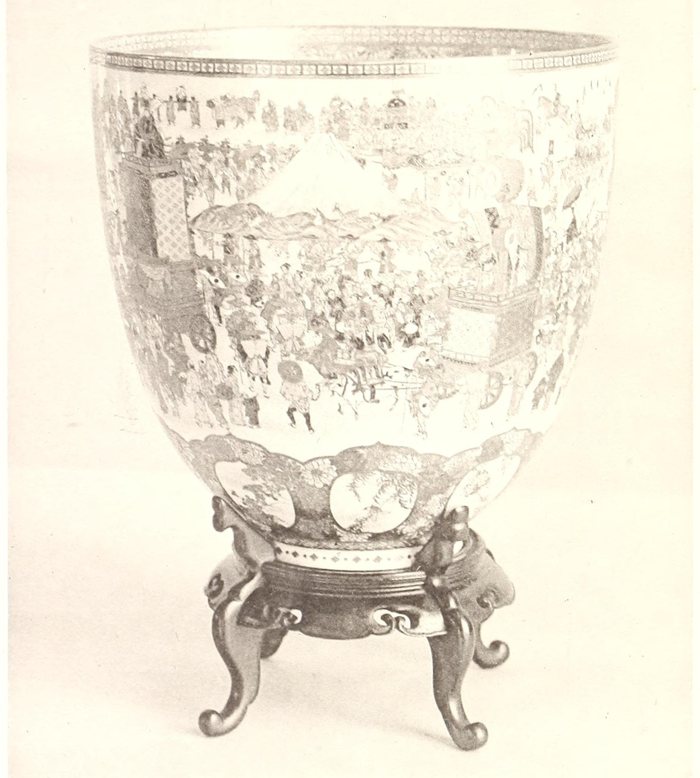
The fairs also shaped what the studio made. Its subjects followed the export market: early Chinese and Buddhist subjects gave way, from around 1890, to Japanese festivals, processions, landscapes and scenes of daily life.9,8
The collectors

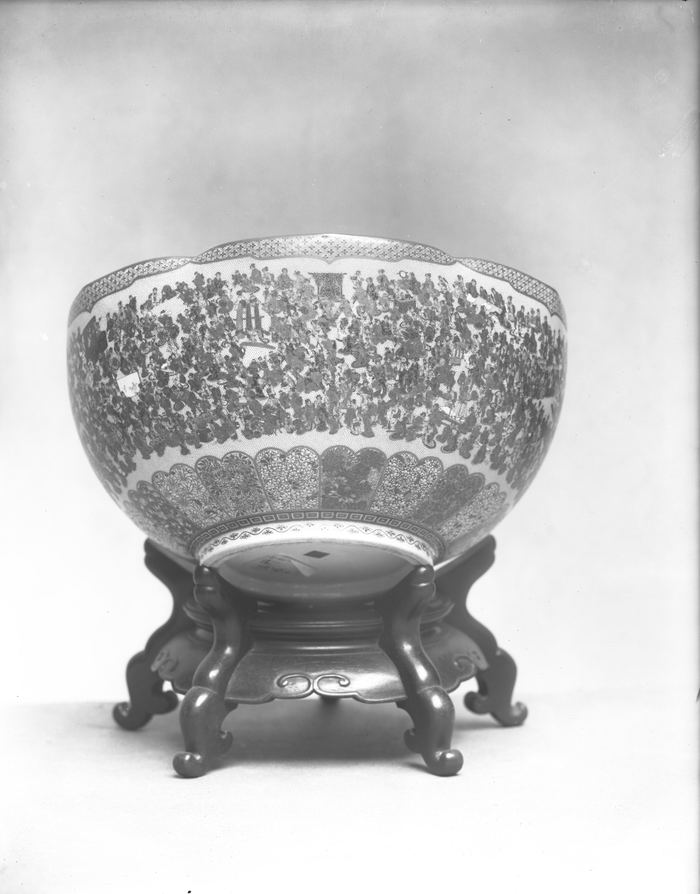


The provenance of Meizan’s surviving works traces the routes by which they left Japan.
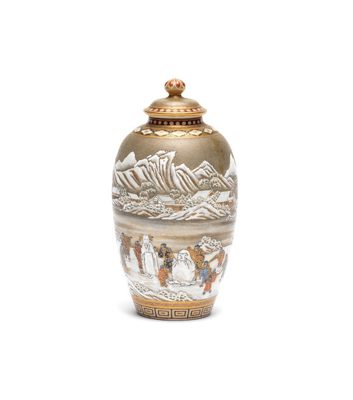
- Michael Tomkinson, an English collector, listed a covered Meizan jar with a snow scene in his catalogue A Japanese Collection (1898). It sold at Bonhams in London in 2014.10
- Charles Parsons of St Louis visited the Osaka workshop in 1894–95 and left one of the few eyewitness descriptions of it.11
- Henry Walters bought a lobed bowl crowded with women at the St Louis exposition of 1904. It is now in the Walters Art Museum, Baltimore.12
- The Victoria and Albert Museum received three Meizan studio pieces in 1910 from Lt-Col. Kenneth Dingwall, with Art Fund support; the museum records that he bought at least two of them at the Japan–British Exhibition that year.13,6
- The Allen Memorial Art Museum at Oberlin College received a Meizan studio bowl in 1904, as part of the Olney bequest.14
After the golden age

The export trade was hit by the First World War, and Meizan retired in 1926.7,5 His work was rediscovered from the late twentieth century, through Japanese research, the Khalili Collection catalogue of 1995 and the Osaka Museum of History.9,15,16
Notes and sources
- “Kindai Nihon ni okeru Ōbei-muke Satsuma-yaki no yushutsu” [The export of Satsuma ware to Europe and America in modern Japan], Kōtsūshi Kenkyū 79 (J-STAGE, Japanese). www.jstage.jst.go.jp/article/kotsushi/79/0/79_KJ00010037865/_pdf/-char/ja
- National Diet Library, “Expositions: Vienna International Exposition and Japonism”. www.ndl.go.jp/exposition/e/s1/1873-2.html
- Amagai Yoshinori, “On the Program of Universal Exhibition 1873 in Vienna”, Bulletin of JSSD 47 (2000). www.jstage.jst.go.jp/article/jssd/47/0/47_2/_article/-char/en
- Osaka Museum of History, special exhibition “Meizan Satsuma no bi” (31 August – 24 October 2005). www.osakamushis.jp/news/2005/meizan.html
- Osaka Museum of History, collection feature “Yabu Meizan”. www.osakamushis.jp/collection/bijutsu/yabumeizan/yabumeizan.html
- Itani Yoshie, “The Design Philosophy of Yabu Meizan: Landscapes of Western Japan in Copperplate”, Journal of the Asian Conference of Design History and Theory 3 (2020), doi:10.18910/90920. ir.library.osaka-u.ac.jp/repo/ouka/all/90920/acdht_03_072.pdf
- Wikipedia, “Yabu Meizan” (citing Library of Congress authority file; Yamazaki Tsuyoshi in Impey and Fairley 1995; Earle 1999; Launius 2020). en.wikipedia.org/wiki/Yabu_Meizan
- Bonhams, New York, 13 September 2017, sale 24293, lot 1286. www.bonhams.com/auction/24293/lot/1286/yabu-meizan-1853-1934-a-large-and-highly-important-satsuma-presentation-vasemeiji-era-1868-1912-early-20th-century
- Satsuma-database, “The Meizan Studio (1880–1941): Yabu Meizan and Yabu Tsuneo” (synthesising the research of Nakano Tomoko, Osaka Museum of History). www.satsuma-database.com/masters-from-edo-meiji-and-taisho-period/8-the-meizan-studio-1880-1941-yabu-meizan-and-yabu-tsuneo
- Bonhams, London, 15 May 2014, sale 21861, lot 464 (Tomkinson provenance). www.bonhams.com/auction/21861/lot/464/a-small-ovoid-satsuma-jar-and-cover-by-yabu-meizan-meiji-period
- Charles Parsons, Notes of a Trip around the World in 1894 and 1895 (St Louis: G. D. Bernard & Co., 1896), p. 27. archive.org/details/notesoftriparoun00pars (full text; first quoted online by Jacksons Antique).
- Walters Art Museum, Baltimore, 49.2280, “Bowl with a Multitude of Women”. art.thewalters.org/object/49.2280
- Victoria and Albert Museum, C.252-1910, C.225-1910 and C.231-1910: each “Given by Lieutenant-Colonel Kenneth Dingwall DSO with Art Fund support, accessioned in 1910”; the records for C.252-1910 and C.225-1910 add that the piece “was bought by their donor at the Japan-British Exhibition held in London in 1910”. O171087, O171086, O496033
- Allen Memorial Art Museum, Oberlin College, 1904.330. allenartcollection.oberlin.edu/objects/2253/bowl-with-interior-design-of-butterflies
- Khalili Collections, Meiji no Takara: Treasures of Imperial Japan. Ceramics, Part Two: Earthenware (Impey and Fairley, 1995). www.khalilicollections.org/portfolio/meiji-no-takara-treasures-of-imperial-japan-ceramics-part-two-earthenware
- Osaka Museum of History, special exhibition “YABU MEIZAN” (3 September – 3 November 2025). www.osakamushis.jp/news/2025/yabumeizan.html