
Yabu Meizan did not come from a family of potters. He came from scholars and painters. His grandfather was a Confucian calligrapher and his father a painter of prints and pictures. The studio he founded was carried on by an heir he adopted. This page sets out what the documents say about the family, and marks clearly where they disagree or fall silent.
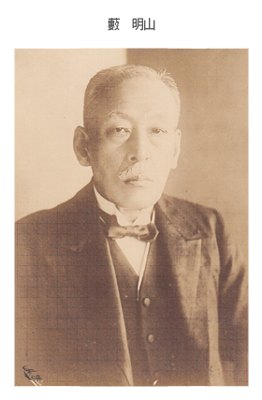
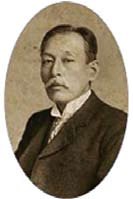
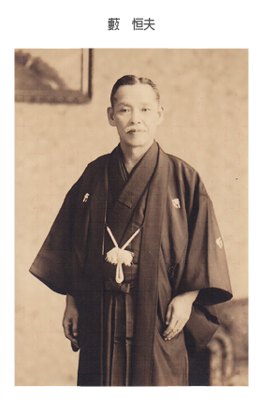
The two portrait photographs of Meizan (left) and Tsuneo (right) are published by the Osaka Museum of History, which holds them, on its 2025 “YABU MEIZAN” exhibition page.3
The grandfather: Yabu Kakudō
Meizan’s grandfather, Yabu Kakudō (1773–1849), was a Confucian scholar and calligrapher from Awaji Island.1,2 The family’s Awaji roots explain why the young Meizan was sent there in 1860.
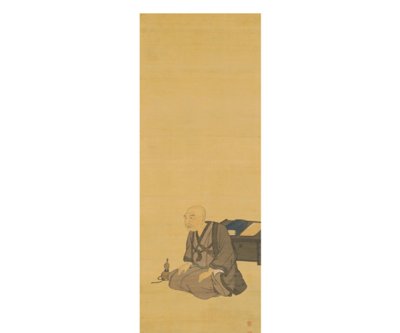
On the name: the Osaka Museum of History writes the grandfather’s name as 藪鶴堂 (Yabu Kakudō) on this exhibition page, as does Nakano’s edition of Meizan’s own curriculum vitae.15,16 No example of Kakudō’s own calligraphy has been found in a public collection online.
The father: Yabu Chōsui, painter
Meizan was the second son of the painter Yabu Chōsui (藪長水).1,3 The Osaka Museum of History dates him 1813–1867 and describes him as a nanga (literati) painter. Itani Yoshie and satsuma-database give 1814–1867.1,2,3 Chōsui also designed surimono, privately published prints made for poetry circles. Examples survive in the Art Institute of Chicago and the Minneapolis Institute of Art, both of which publish them as public domain.4,5
A note on identity. Chicago gives this artist’s dates as “1814–c. 1870” and Minneapolis as “1813–1867”. The name, the Osaka print circles and the years all match Meizan’s father as the Osaka Museum describes him. Neither museum, however, states the family link in its record. The prints are shown here as the work of Yabu Chōsui. That he is the same man as Meizan’s father is a strong inference, not a documented fact.


No source shows that Meizan was trained in painting by his father. Chōsui died when Meizan was fourteen, and satsuma-database points out that “available sources offer no evidence that he studied painting under his father”.2 What the family probably gave him was a cultivated eye for design and the classical subjects that run through the studio’s work.
More prints and paintings by Yabu Chōsui
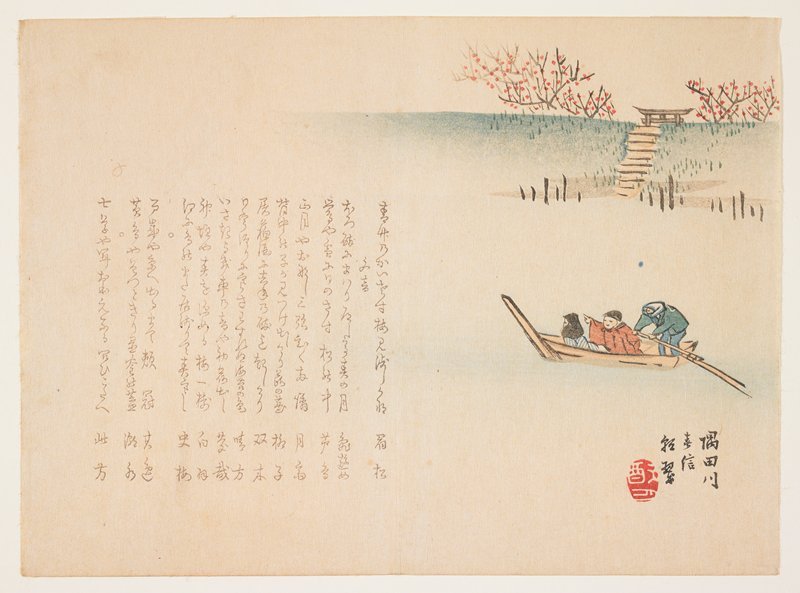
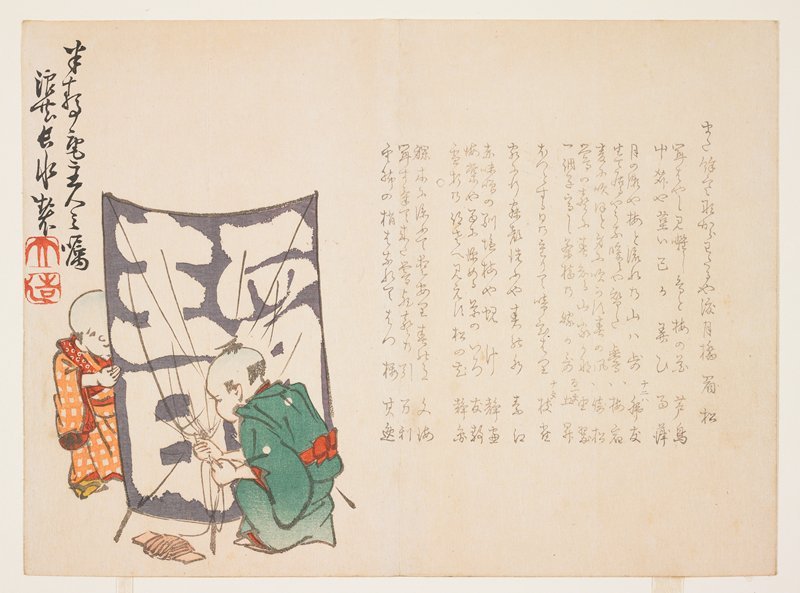
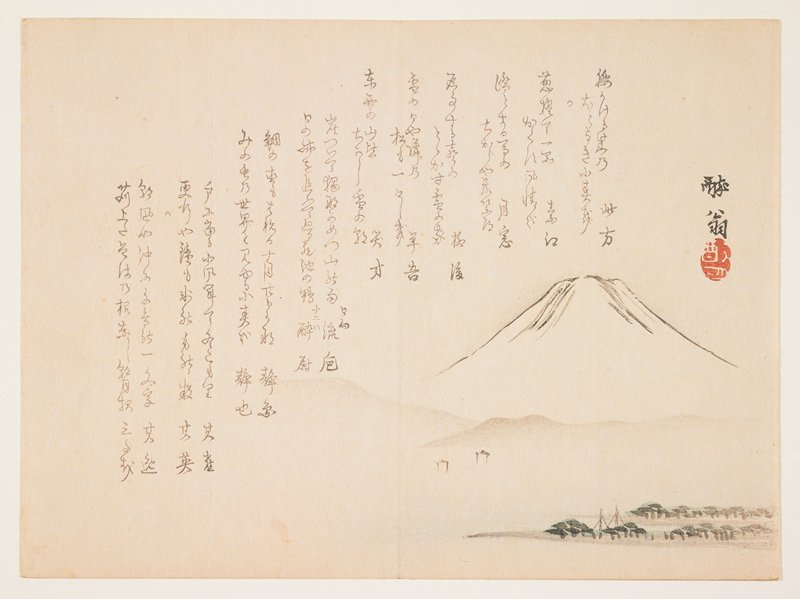
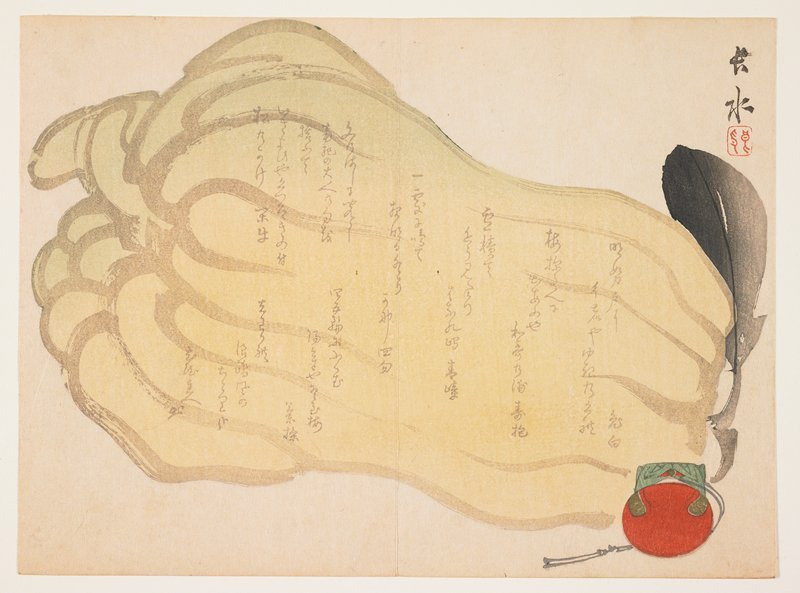
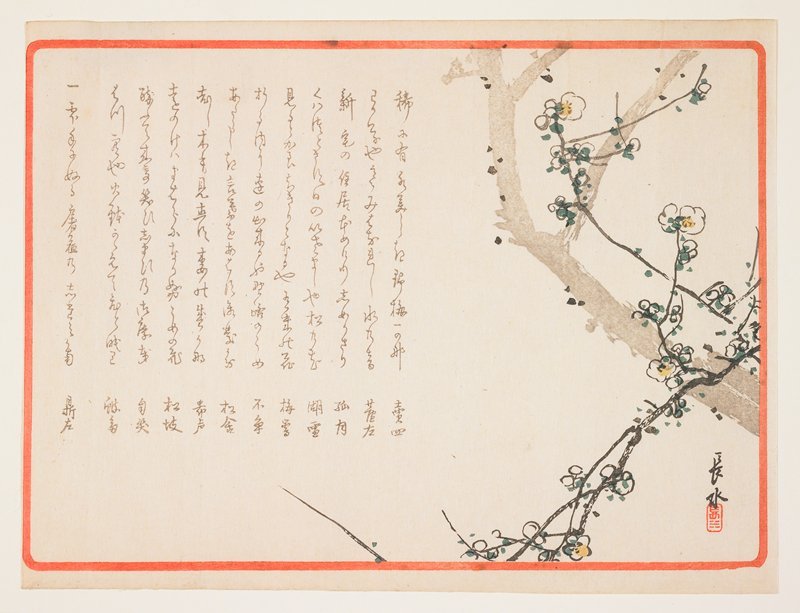
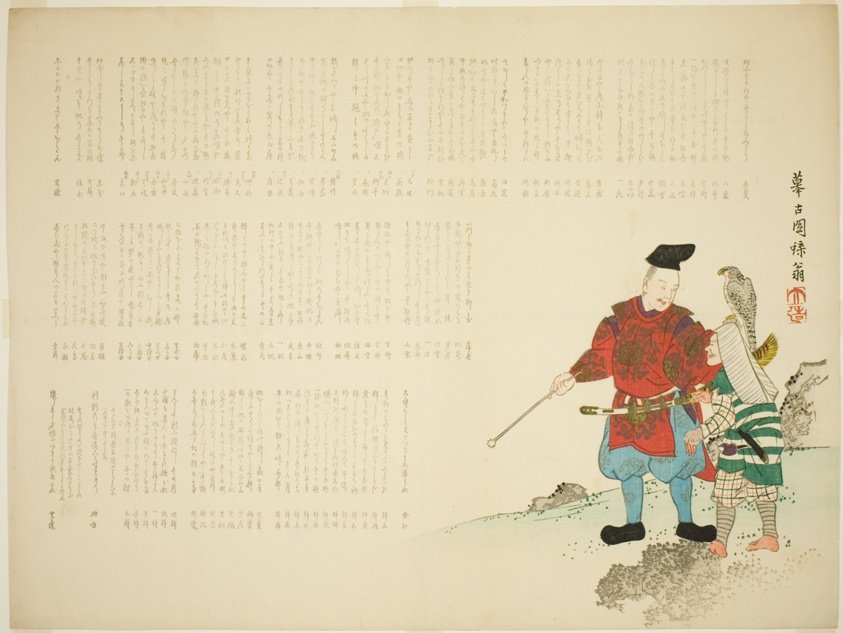


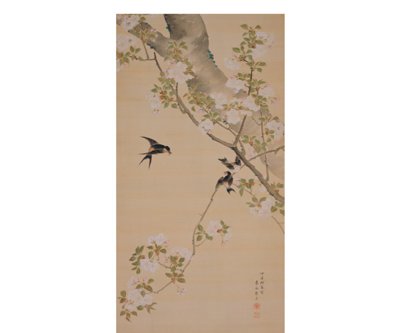
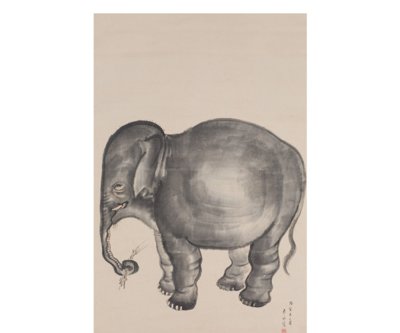
The Chicago and Minneapolis records do not state that their artist is Meizan’s father; see the note on identity above. The two paintings are attributed to Chōsui by the Osaka Museum of History.16
Note: we checked the name “Yabu Masanobu” for Meizan’s father and found no source that uses it. The Osaka Museum of History, Itani (2020) and satsuma-database all name him as Yabu Chōsui.
Childhood heir to another branch, 1860
In 1860 the seven-year-old Masashichi was made heir to the Yabu Sukezaemon family and moved to Fukura on Awaji. There he studied calligraphy and the classics with the head priest of Shinkōji temple, and later Chinese classics and painting with Tadokoro Atsurō, a samurai of Sumoto. Around 1868 he returned to Osaka for a commercial training.1,2

Wife, faith and partners
Meizan’s wife was named Kayo. She is known chiefly through her family’s role in adopting Tsuneo (below). We have not found her dates or the kanji of her name in a primary source.2 Meizan became a Christian. His closest business partner, the Satsuma dealer Hirase Yoichirō, was also a Christian with ties to American Board missionaries. Meizan’s funeral in 1934 was held at Naniwa Church, Osaka.2,6

On the name: the Osaka Museum of History writes Kayo’s name in katakana, カヨ; the kanji remain unconfirmed.3
The heir: Yabu Tsuneo, the second Meizan
Yabu Tsuneo (藪恒夫, 1868–1941) was born into a samurai family of Tsuyama in Okayama prefecture. The Osaka Museum of History names the family as Nakanishi (中西). Other sources differ on the family name (see Open questions).2,3 In 1883 he was adopted by the mother of Meizan’s wife Kayo, which made him Meizan’s brother-in-law. In 1895 he entered the Yabu family as Meizan’s legal heir.2,3 He was already working in the studio before then: an 1891 Manchester Guardian report, quoted by Louis Lawrence, calls him Meizan’s “brother”.2,7
When Meizan retired in 1926, Tsuneo took over the studio as the second Meizan. He signed simply “Meizan” (明山), not “Yabu Meizan” and never “Meizan II”. He ran the studio until his death in 1941, which closed it.2,8 The few works attributed to him are small and livelier, sometimes humorous, in tone. They include a pair of gourd-shaped vases sold at Bonhams.2,9 Nakano Tomoko’s research draws on family archives, including Tsuneo’s own notes on Meizan’s life.2
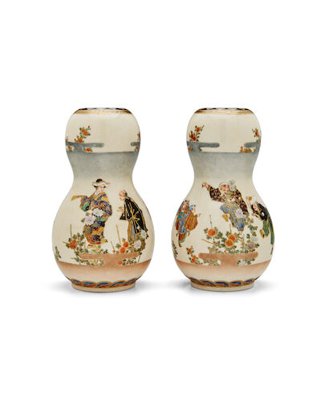
See Marks & Signatures for how to tell the Tsuneo “Meizan” mark from the founder’s “Yabu Meizan” seal.
What Louis Lawrence’s 2011 book says about the family
Lawrence’s short biography gives Meizan as “the second son of painter Yabu Chosui” (Chōsui), and says he “trained as a ceramic decorator in his youth” (p. 25). His directory entry has Meizan (1853–1934) training “as a ceramic maker in Awaji and Tokyo” before setting up on his own in Osaka in 1880 (p. 242). The two passages differ from each other, and from the account above, which follows Nakano Tomoko: heir to the Yabu Sukezaemon family on Awaji, with a classical and commercial education. All three are given here and none is preferred.13
The Manchester Guardian report of 1891, which Lawrence reprints, speaks of “Mr. (Yabu) Meizan and his brother” and calls them “the sons of a Japanese painter”.14 Read literally, this describes a brother by birth. Read against Nakano’s research, the man is more likely to be Tsuneo, who was Meizan’s brother-in-law by adoption. The report does not name him, so the identification is not confirmed.
For Tsuneo, Lawrence’s directory reproduces two marks reading simply “Meizan”, captioned “used by Yabu Tsuneo, Meizan’s adopted son, after his own retirement in 1926” (entry 131, p. 242). This agrees with the 1926 handover described above. The “Dai Nihon Meizan” mark he shows separately, under the founder’s own entry (130b in our numbering), and calls “very scarce”, used “on exception pieces”. The same page (p. 242) has two entries numbered 130, a numbering slip in the book; we call them 130a and 130b. The other one, 130a, a “Dai Nihon koku, Satsuma yaki, Ansei Meizan” mark, is a different decorator. He also notes that monkeys, rare in the founder’s work, appear on a gourd-shaped vase in the later, simpler style. He links that style to the studio’s exhibits from 1915 (p. 178).13
Decorators, not pupils
The studio’s painters were employees, not named pupils. Charles Parsons found “17 men and boys at work, all decorating” on his visit in 1894–95.10 In 1910 the critic H. Shugio described the studio’s “pupils hard at work in decorating pottery”.11 None of their names has been published, so this archive does not attribute any work to an individual decorator.

The family business in print
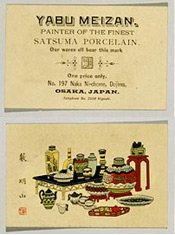
The studio presented itself to foreign buyers through printed material. Its English trade card of 1904 reads “Yabu Meizan, Painter of the Finest Satsuma Porcelain … Dojima, Osaka”.


Where the family worked
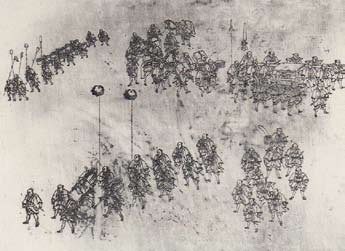
The Osaka Museum of History says the studio opened in October 1880 at Nakanoshima 2-chōme, Kita-ku.3 Meizan’s curriculum vitae, as edited by Nakano, gives his address as Dōjima Naka 2-chōme 44, and records a move within Kita-ku when the premises became too small.15 No photograph of the studio building itself has been found. The views below show the district.


After 1941: loss and rediscovery
Family records say the studio buildings were destroyed in the bombing of Osaka. The year is uncertain (see Open questions).2 Nakano notes that after Tsuneo’s death the Meizan name largely faded from memory in Japan. It was revived from 1991 “through the efforts of his descendants”, followed by the Osaka Museum of History exhibitions of 2005 and 2025.2,3,12 The descendants are not named in the sources we have read, and we do not name them here.


The photographs show the bombing of Osaka in general. Neither shows the studio.
藪家の人々
藪明山(本名・政七、1853–1934)は、陶工の家ではなく学者と画家の家に生まれた。祖父は淡路出身の儒学者・書家、藪鶴堂(かくどう、1773–1849。表記は大阪歴史博物館および中野朋子による)15,16。父は大坂の画家、藪長水(1813/14–1867)で、大阪歴史博物館は南画家と紹介している。長水は摺物も手がけ、作品はシカゴ美術館およびミネアポリス美術館にパブリックドメインとして所蔵される。ただし、両館の記録は明山の父であることに触れておらず、同一人物とするのは有力な推定である。
明山が父から絵を学んだことを示す史料はない。父の名を「藪 Masanobu」とする史料は見いだせなかった。
万延元年(1860)、藪 Sukezaemon(すけざえもん)家の養嗣子となり淡路・福良へ移る。明治元年(1868)頃に大坂へ戻った。妻の名は Kayo(かよ、漢字表記・生没年は未確認)。明山はキリスト教に入信し、昭和9年(1934)の葬儀は大阪・浪花教会で営まれた。
後継者の藪恒夫(1868–1941)は津山の士族の出身で、生家は中西家とされる(中川家とする記述もある)。明治16年(1883)に妻 Kayo の実母の養子となり、明治28年(1895)に明山の養嗣子として藪家に入った。大正15年(1926)の明山引退後に二代明山として工房を継ぎ、落款は「明山」のみを用いた。昭和16年(1941)の恒夫の死去により工房は閉じられた。家伝によれば、工房は戦災で焼失したという(年は1944年と1945年の両説あり)。
戦後、明山の名は国内で忘れられたが、1991年以降に子孫の尽力で再評価が進み、2005年と2025年には大阪歴史博物館で展覧会が開かれた。
Notes
- Itani Yoshie, “The Design Philosophy of Yabu Meizan: Landscapes of Western Japan in Copperplate”, Journal of the Asian Conference of Design History and Theory 3 (2020), doi:10.18910/90920. ir.library.osaka-u.ac.jp
- Satsuma-database, “8. The Meizan Studio (1880–1941): Yabu Meizan and Yabu Tsuneo” (drawing on Nakano Tomoko, Osaka Museum of History research bulletins 2019–2025). satsuma-database.com
- Osaka Museum of History, special exhibition “YABU MEIZAN” (2025) and collection page. osakamushis.jp
- Art Institute of Chicago, works by Yabu Chōsui, e.g. Portrait of a Rabbit, 1867, 1972.1434 (CC0). artic.edu/artworks/42068
- Minneapolis Institute of Art, Yabu Chōsui, Tidings of Spring on the Sumida River, c. 1863, P.77.27.26 (artist dates 1813–1867; Public Domain). collections.artsmia.org/art/42532
- Wikipedia, “Yabu Meizan” (citing Yamazaki 1995; Earle 1999; Launius 2020). en.wikipedia.org/wiki/Yabu_Meizan
- Louis Lawrence, Satsuma: The Romance of Japan (2011), p. 252, as quoted by satsuma-database.
- Gotheborg.com, Satsuma marks, no. 477 (“used by Yabu Tsuneo … after Meizan’s retirement in 1926”). gotheborg.com
- Bonhams, sale 25575, lot 875, “Yabu Tsuneo (active after 1926): a pair of gourd-shaped Satsuma vases”. bonhams.com
- Charles Parsons, Notes of a Trip around the World in 1894 and 1895 (1896), p. 27. archive.org (full text)
- H. Shugio, “Japanese Art and Artists of To-day. II. Ceramic Artists”, The International Studio 41, no. 164 (October 1910), pp. 286–288. archive.org
- Osaka Museum of History, 「明山薩摩の美―万国博覧会で愛された近代大阪のやきもの―」 (2005). osakamushis.jp
- Louis Lawrence, Satsuma: The Romance of Japan (Meiji Satsuma Publications, 2011; produced by CA Design, Hong Kong), ISBN 978-962-7502-79-1, pp. 25, 178, 242.
- The Manchester Guardian, 15 October 1891, reprinted in Lawrence 2011, Appendix 2, pp. 252–253 (public domain text).
- Nakano Tomoko (中野朋子), 「明山藪政七履歴書」, Ōsaka Rekishi Hakubutsukan kenkyū kiyō 17, pp. 61–72, doi:10.34570/omhbull.17.0_061. jstage.jst.go.jp
- Osaka Museum of History, special exhibition 「幕末大坂の絵師 藪長水」 (12 March – 14 April 2014). osakamushis.jp