
Yabu Meizan’s art belongs to a specific moment: the Meiji era (1868–1912), when Japan presented its crafts to the world at international expositions and decorated ceramics known abroad simply as “SATSUMA” became one of its most recognisable exports. These essays set his studio in that context.

The Meiji golden age
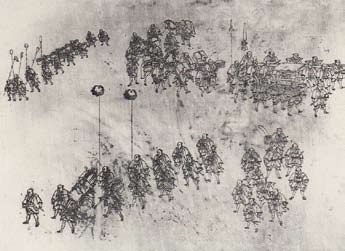
The world’s fairs, the government’s promotion of export crafts, and the collectors in Europe and America who bought Meizan’s work, from Michael Tomkinson to Henry Walters.

Satsuma ware: Kagoshima, Kyoto and Osaka
From the Korean potters of Kagoshima to the decorating studios of Kyoto, Osaka and Kobe. Covers the difference between “Hon-Satsuma” and “Kyo-Satsuma”, and how a Meizan piece was made.
Three things to know

“Satsuma” is a style, not only a place
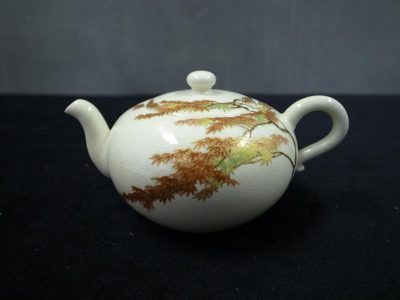
Satsuma ware originated in Kagoshima, but by the Meiji era similar wares were decorated in Kyoto, Osaka, Kobe and Yokohama. Abroad, all of them were sold as “SATSUMA”.1,2
Decorators, not potters
Meizan’s studio bought undecorated blanks from Kyoto and Kagoshima and painted them in Osaka. It never fired its own bodies.3,4

Inside the studio: what Louis Lawrence’s book adds
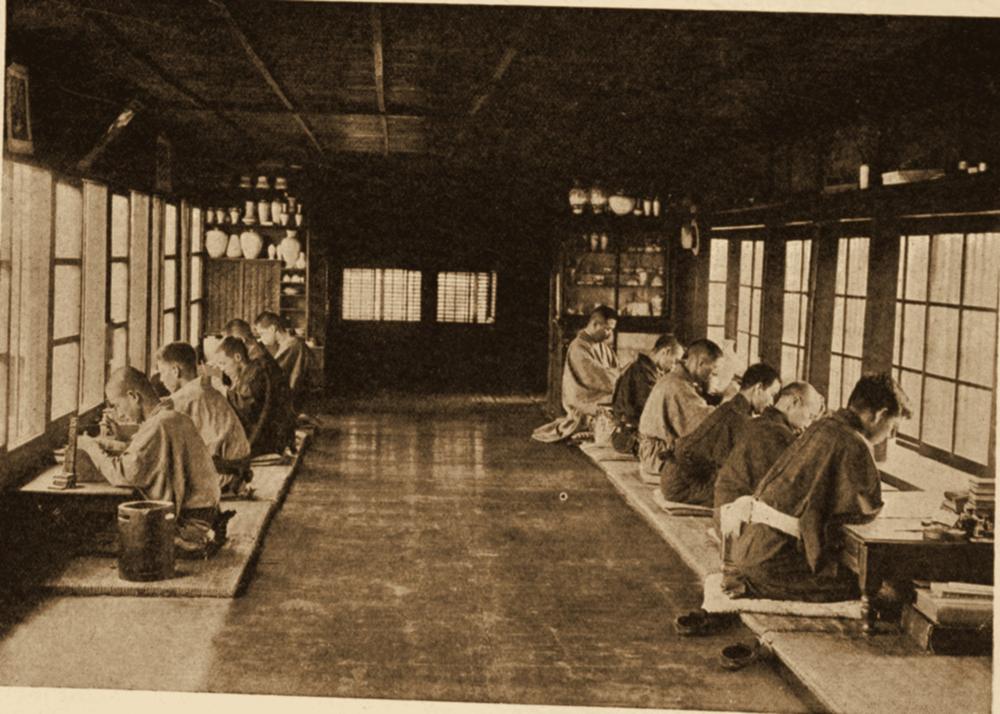
A visit in 1891. The most direct description of the studio at work is a report in the Manchester Guardian of 15 October 1891, reprinted in Lawrence’s Appendix 2. Its correspondent describes Meizan and his brother as the sons of a painter. About eleven years earlier, he says, Meizan had decided that much new Satsuma was badly painted and set out to improve its sale by covering it with “fine and delicate painting”. The work was done in a small workshop with about twelve trained painters. An “accomplished draughtsman” drew the design in black, and the gold and the finest work, such as faces, draperies and crowds of butterflies, were shared among hands of differing skill. Some of the work needed a magnifying glass to be seen properly. The working day ran from twelve to fifteen hours, the best painters worked shorter days, and the workshop closed on Sundays. “Each piece is signed Meizan.” The report also says that “Mr. Meizan is, moreover, a Christian”.9
Copper plates. Lawrence dates the studio’s engraved copper plates to “sometime in the late 1880s or early 1890s”, following Yamazaki Tsuyoshi’s essay in the Khalili catalogue. Outlines, or whole scenes, were printed onto paper from the plate and transferred to the blank as an underdrawing. Lawrence argues that this let Meizan control both quality and cost, so that the gap between his best and worst pieces was smaller than at other studios. An early freehand vase of the late 1880s and a copper-plate vase of about 1910 show the difference (see the catalogue entries for Lawrence pls. 23 and 24).8
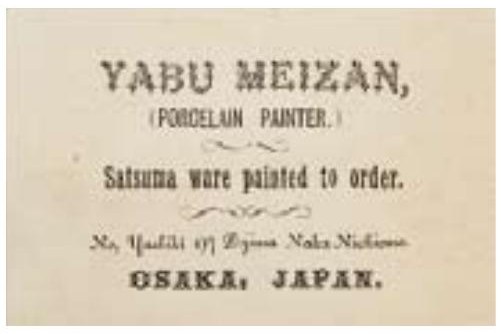
How a piece was sold. Lawrence writes that Meizan was one of the few Satsuma decorators who did not sell through dealers or retailers. Buyers came to the studio, were served tea, and were shown pieces one at a time from their wooden boxes (tomobako). Lawrence writes that one of Meizan’s business cards states that prices were fixed (p. 40). The side of that card reproduced in the book, however, reads “Satsuma ware painted to order”, like the second card. Another reads “Satsuma ware painted to order”, which Lawrence takes to mean that the studio would put the subjects a client chose onto blanks already in stock, within the range of its copper plates. He does not read it as a promise to paint anything at all.8 This is Lawrence’s account; other sources record the studio’s partnership with the Satsuma dealer Hirase Yoichirō (see The Yabu Family).
Copies in his own lifetime. Lawrence illustrates a Meiji-period globular vase that carries a Meizan mark but which he judges to be a contemporary copy. It is painted entirely freehand with a continuous landscape in grey tones, and the mark itself is hand-painted with an unsteady hand. He notes that one of Meizan’s business cards warns, “Our wares all bear this mark.” For his directory, Lawrence reproduces several forged signatures alongside the genuine marks.8 See Marks & Signatures.
For the life of the artist himself, see the biography. For the marks that identify his work, see Marks & Signatures.
Notes and sources
- Kagoshima Prefectural Museum of Culture Reimeikan, “Satsuma-yaki” (Japanese). www.pref.kagoshima.jp/reimeikan/josetsu/bumon/art/satsumayaki/index.html
- Kiyomizu Sannenzaka Museum, Kyoto, special exhibition “Kyoto Satsuma ware”. sannenzaka-museum.co.jp/en/special_exhibition/%e4%ba%ac%e8%96%a9%e6%91%a9-3-2
- Osaka Museum of History, collection feature “Yabu Meizan”. www.osakamushis.jp/collection/bijutsu/yabumeizan/yabumeizan.html
- Satsuma-database, “The Meizan Studio (1880–1941): Yabu Meizan and Yabu Tsuneo” (synthesising the research of Nakano Tomoko, Osaka Museum of History). www.satsuma-database.com/masters-from-edo-meiji-and-taisho-period/8-the-meizan-studio-1880-1941-yabu-meizan-and-yabu-tsuneo
- Osaka Museum of History, special exhibition “Meizan Satsuma no bi” (31 August – 24 October 2005). www.osakamushis.jp/news/2005/meizan.html
- Itani Yoshie, “The Design Philosophy of Yabu Meizan: Landscapes of Western Japan in Copperplate”, Journal of the Asian Conference of Design History and Theory 3 (2020), doi:10.18910/90920. ir.library.osaka-u.ac.jp/repo/ouka/all/90920/acdht_03_072.pdf
- Wikipedia, “Yabu Meizan” (citing Library of Congress authority file; Yamazaki Tsuyoshi in Impey and Fairley 1995; Earle 1999; Launius 2020). en.wikipedia.org/wiki/Yabu_Meizan
- Louis Lawrence, Satsuma: The Romance of Japan (Meiji Satsuma Publications, 2011; produced by CA Design, Hong Kong), ISBN 978-962-7502-79-1, pp. 24–25, 40, 44–47 (incl. n. 20), 64–68, 242.
- “The Princes of Satsuma…”, The Manchester Guardian, 15 October 1891 (from our correspondent), reprinted in Lawrence 2011, Appendix 2, pp. 252–253. The 1891 text is in the public domain.