
Works from the Meizan studio are held by public and private collections in Britain, the United States and Japan. The list below includes only records we have confirmed on each museum’s own collection website or publications, with accession numbers and links so that every entry can be checked at its source.
Britain 16 objects

Victoria and Albert Museum, London, Cromwell Road façade, c. 1935 (Donald McLeish). Donald McLeish. Public domain, via Wikimedia Commons

British Museum, London: the Great Court. Diliff. CC BY-SA 3.0, via Wikimedia Commons

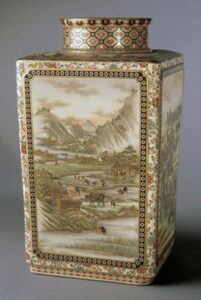
Large rectangular vase with four pictorial panels, c. 1890. Khalili Collection, S 148. Khalili Collections. CC BY-SA 4.0, via Wikimedia Commons

Ashmolean Museum, Oxford. Remi Mathis. CC BY-SA 3.0, via Wikimedia Commons
United States 5 objects

Walters Art Museum, Baltimore, Charles Street. Walters Art Museum. CC BY-SA 3.0, via Wikimedia Commons

The Metropolitan Museum of Art, New York, Fifth Avenue entrance. Arad. CC BY-SA 3.0, via Wikimedia Commons

Allen Memorial Art Museum, Oberlin College (Cass Gilbert, 1917). Daderot. Public domain, via Wikimedia Commons

Minneapolis Institute of Art (photograph c. 1980). City of Minneapolis Archives from Minneapolis, United States. CC BY 2.0, via Wikimedia Commons
Japan 3 objects

The Osaka Museum of History (大阪歴史博物館), home of the principal Japanese research collection on Meizan; photographed 2015. そらみみ (Soramimi). CC BY-SA 4.0, via Wikimedia Commons

Shigaraki Ceramic Cultural Park, Kōka, Shiga. 663highland. CC BY 2.5, via Wikimedia Commons
24 objects in 10 collections are listed below as of 19 October 2026; 21 objects in 9 collections have completed review. The Khalili Collection has no public gallery; it is represented by one of its own Meizan photographs.
Allen Memorial Art Museum, Oberlin College
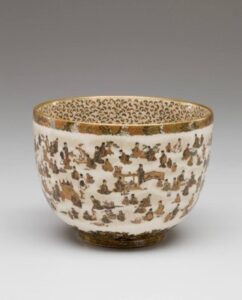
- Bowl with butterflies in the interior View photos at the Allen Memorial Art Museum (opens external site)A bowl from the studio of Yabu Meizan, with butterflies decorating the interior. Dated late 19th century; dimensions 8.9 x 12.7 cm. Bequest of Charles F. and Abigail L. Olney,…
Ashmolean Museum, Oxford
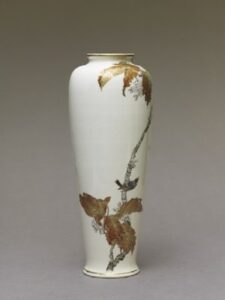
- Vase with a bird on a flowering cherry branch Linked to London 1910: The museum links its style to the Japan–British Exhibition of 1910; not itself recorded as exhibited View photos at the Ashmolean (opens external site)A vase with a single bird perched on a flowering cherry branch against an open ground, in the sparer style of about 1910. Dated c. 1910; dimensions h 25 cm;…
British Museum, London
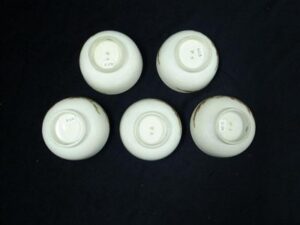
- Five tea-bowls from a sencha set with maple View photos at the British Museum (opens external site)Five small tea-bowls completing the British Museum's Meizan sencha service, each decorated with maple. Dated 1880–1908. Workshop name in overglaze gold on the base. Accession numbers 2014,3064.27.c to .g, all…
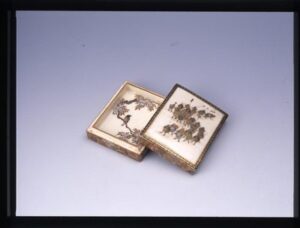
- Small lidded box with a daimyo procession View photos at the British Museum (opens external site)A small lidded box in Satsuma style, with a daimyō procession on the outside and birds and flowers inside, recorded by the British Museum as made by Yabu Meizan.
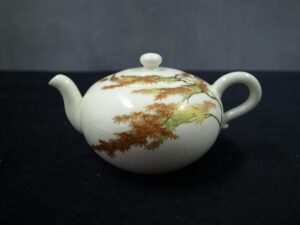
- Teapot and lid from a sencha set with maple View photos at the British Museum (opens external site)The teapot from a sencha tea service decorated with maple in the Meizan workshop. The museum catalogues the stoneware body as made in Kagoshima and the decoration as done in…
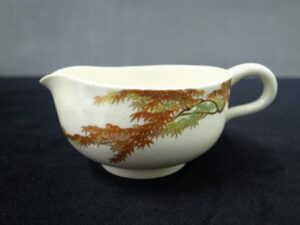
- Water-jug and storage box from a sencha set with maple View photos at the British Museum (opens external site)The water-jug, with its storage box, from the British Museum's Meizan sencha service with maple decoration. Dated 1880–1908. Described by the museum as 'water-jug; storage box'. Part of the Hyatt…
Khalili Collection of Japanese Art, London
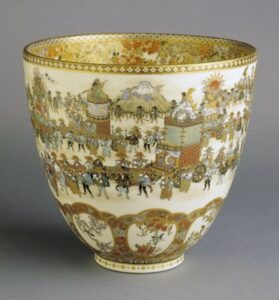
- Bowl with a festival procession and a Mount Fuji float Twin shown London 1910: An almost identical bowl was shown at the Japan–British Exhibition, London, 1910 View photos at the Khalili Collections (opens external site)A bowl showing a festival procession with a model of Mount Fuji carried on a float, with butterflies inside. A banner in the procession bears the inscription 'Dai Meizan'.
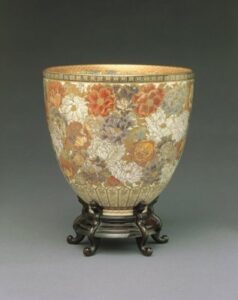
- Bowl with peonies and wisteria View photos at the Khalili Collections (opens external site)A deep bowl crowded with peonies outside, with trailing wisteria within. Dated 1900–1910; dimensions d 15.3 cm. Published: Impey and Fairley (eds.), 1995, cat. 66; J. Earle, Splendors of Imperial…
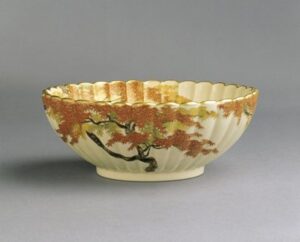
- Fluted bowl with an autumn maple View photos at the Khalili Collections (opens external site)A fluted, chrysanthemum-form bowl with a single autumn maple, an example of the sparer style the studio introduced around 1910. Dated c. 1910; dimensions d 14.8 cm. Published: Impey and…
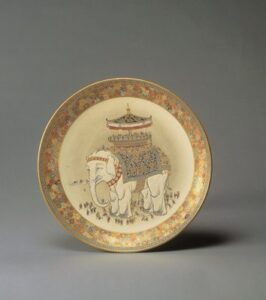
- Large plate with a caparisoned white elephant and karako View photos at the Khalili Collections (opens external site)A large plate with a caparisoned white elephant overrun by karako boys, within a millefleurs and key-fret border; an early showpiece design of about 1890.
- Large rectangular vase with four pictorial panels View photos at the Khalili Collections (opens external site)A large rectangular vase with four panels: rice farmers, chrysanthemum viewers, fishermen, and monkeys after a design by Mori Sosen. Dated c. 1890; dimensions h 37 cm. Published: Impey and…
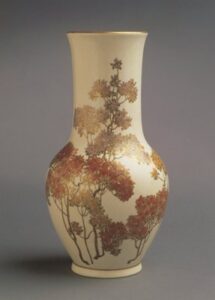
- Ovoid vase with rhododendron View photos at the Khalili Collections (opens external site)An ovoid vase with a wide neck painted with stems of rhododendron in white, orange, purple and yellow; a late, single-motif work of 1910–1915. Dated 1910–1915; dimensions h 21.7 cm.…
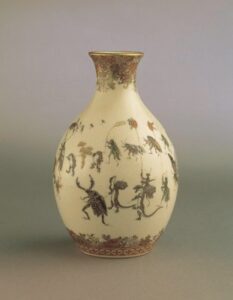
- Vase with an insect daimyo procession View photos at the Khalili Collections (opens external site)A small vase with a daimyō procession acted out by insects, lizards and frogs, in the tradition of the Chōjū giga scrolls. Dated c. 1910; dimensions h 11.7 cm. Published:…
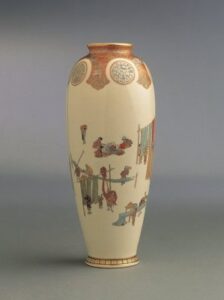
- Vase with silk decorators at work View photos at the Khalili Collections (opens external site)A vase with silk being decorated, dried and folded; the Osaka City Museum holds the original copper-plate design, donated by the Yabu family. Dated c. 1910; dimensions h 18 cm.…
Metropolitan Museum of Art, New York
- No image publishedView at The MetGoblet with a Satsuma bowl in the style of Yabu Meizan (Shreve & Company) View photos at The Met (opens external site)An American silver goblet by Shreve & Company of San Francisco, mounting a Japanese Satsuma bowl. The Met describes the bowl only as in the style of Yabu Meizan; it…
- No image publishedView at The MetSmall bowl with banded millefleurs and butterflies View photos at The Met (opens external site)A small bowl with diagonal bands of millefleurs on the outside and butterflies within. Dated late 19th century; dimensions h 4.1 cm; d 7.6 cm. Catalogued by the Met as…
Minneapolis Institute of Art
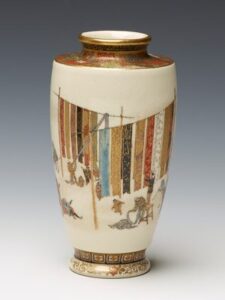
- Vase with figures drying, sorting and packing cloth View photos at Mia (opens external site)Satsuma ware, earthenware painted in overglaze enamels and gilt. Mark: gilt 藪明山 on red. Gift of John C. Weber. Dated early 20th century; dimensions 11.7 × 5.7 × 5.7 cm.…
Museum of Contemporary Ceramic Art, Shigaraki Ceramic Cultural Park
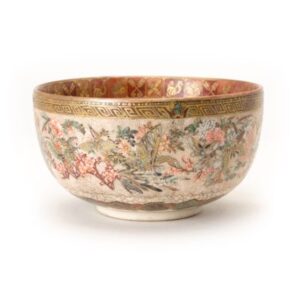
- Bowl with birds and butterflies among peonies View photos at the Shigaraki Ceramic Cultural Park (opens external site)A bowl painted with birds and butterflies among peonies, from the Tetsuro Tanabe Collection.
Osaka Museum of History
- Large vase with Mount Fuji, wisteria and peacocks View photos at the Osaka Museum of History (opens external site)A large vase painted with Mount Fuji, wisteria and peacocks, held by the principal Japanese research collection of Meizan's work. Dated 1897–1926. Japanese title 富士・藤・孔雀図大花瓶. Gift of Morita Kazuko. The…
- Vase with a view of Miyajima View photos at the Osaka Museum of History (opens external site)A vase depicting the shrine at Itsukushima (Miyajima) in fine overglaze painting, its interior densely filled with flowers. A large crack in the body was repaired in recent conservation.
Victoria and Albert Museum, London
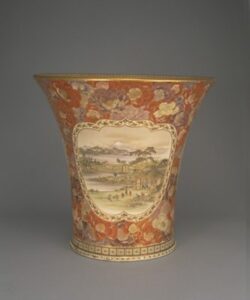
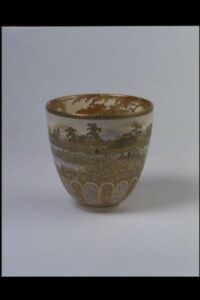
- Deep bowl with views of the countryside London 1910: Bought at the Japan–British Exhibition, London, 1910 View photos at the V&A (opens external site)A deep bowl from the Meizan workshop, painted in overglaze enamels and gold over a crackled cream glaze with views of the Japanese countryside. It was bought at the Japan–British…
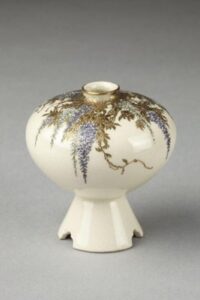
- Miniature vase with wisteria on a pierced foot London 1910: Bought at the Japan–British Exhibition, London, 1910 View photos at the V&A (opens external site)A miniature vase from the Meizan workshop, with wisteria on the shoulder and a conical foot pierced with trefoil openings. Its mark is a standard reference for the studio's square…
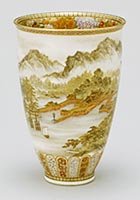
- Ovoid vase with landscape scenes London 1910: Bought at the Japan–British Exhibition, London, 1910 View photos at the V&A (opens external site)A vase from the Meizan workshop, entered in the museum's 1910 register as decorated faience from Osaka. Like its companions at the V&A, it came to the museum in 1910.
Walters Art Museum, Baltimore
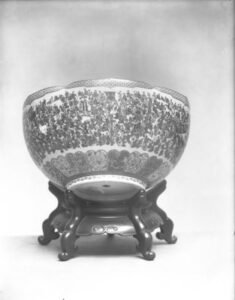
- Bowl with a Multitude of Women St Louis 1904: Shown at the Louisiana Purchase Exposition, St Louis, 1904, and bought there by Henry Walters View photos at the Walters Art Museum (opens external site)A six-lobed foliate bowl crowded with women, painted in overglaze enamels and gold. It was bought by Henry Walters at the St Louis exposition of 1904.
The collections
Victoria and Albert Museum, London

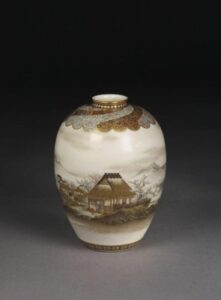
The V&A’s three Meizan pieces come from the Japan–British Exhibition in London in 1910 and entered the museum as a gift, credited “Presented by Lieutenant-Colonel Kenneth Dingwall DSO with Art Fund support”. They are a bowl with country views (C.252-1910) and two vases (C.225-1910 and C.231-1910). All three came as a Dingwall gift made with the support of the Art Fund.1,2,3 The museum’s records describe the standard mark precisely, as “‘Yabu Meizan’ in a square gilt panel”, which makes them an important reference group for the studio’s signature.1,3
British Museum, London
The British Museum’s record for Yabu Meizan (BIOG3788) lists 8 related objects (checked 22 October 2026); the four entries below cover all 8 (see Open questions). Most belong to a sencha tea service decorated with maple: a teapot, a water-jug with its storage box, and five tea-bowls. It was given by David and Anne Hyatt King through the Art Fund.4,5 The museum catalogues the service with a body made in Kagoshima and decoration done in Osaka, a clear illustration of how the studio worked.5 The ninth object is a small lidded box with a daimyō procession, bequeathed by Captain Collingwood Ingram. Its online record carries a date of “18th–19th century”, which cannot be reconciled with Meizan’s dates and should be read as a cataloguing anomaly.6
The Khalili Collection of Japanese Art
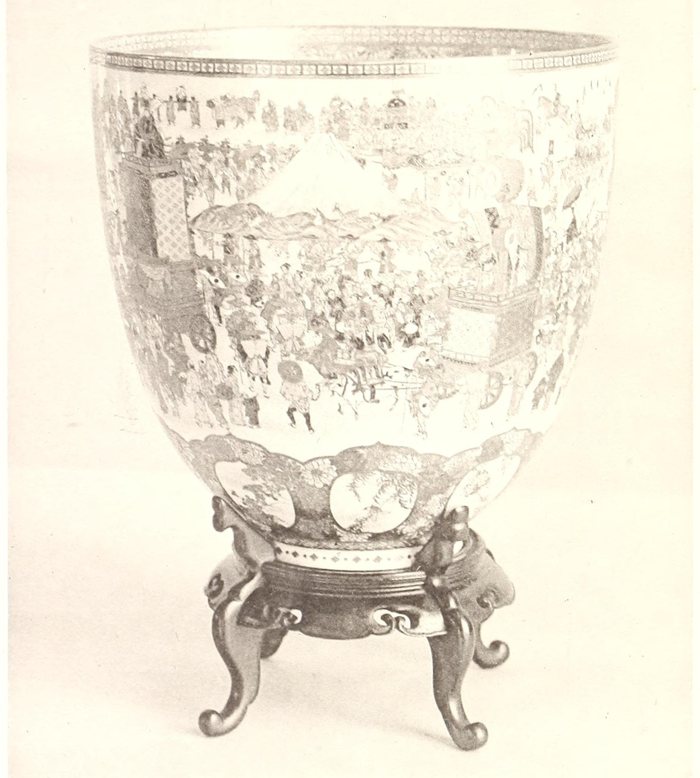
The Khalili Collection holds the largest group of Meizan’s work anywhere. Its 1995 catalogue by Oliver Impey and Malcolm Fairley, with a biography by Yamazaki Tsuyoshi, covers 171 earthenwares by Meizan and related makers.7 Two bowls illustrate the range. S 30 shows a festival procession with a model of Mount Fuji, and a banner in the scene is inscribed “Dai Meizan”; an almost identical bowl was shown at the Japan–British Exhibition of 1910. S 128, a fluted bowl with a single autumn maple, represents the sparer style of about 1910.8,9
Walters Art Museum, Baltimore


The Walters’ “Bowl with a Multitude of Women” (49.2280), a six-lobed bowl crowded with figures, has an exceptional provenance. It was shown at the Louisiana Purchase Exposition in St Louis in 1904, bought there by Henry Walters, and bequeathed to the museum in 1931. The museum notes that Meizan obtained his blanks from Chin Jukan and Kinkozan.10
The Metropolitan Museum of Art, New York
The Met holds a small bowl with diagonal bands of millefleurs outside and butterflies within (46.39.11), given by Philip A. Rollins in 1946. The museum catalogues its material as porcelain; the V&A, the British Museum, the Khalili Collection and the Ashmolean describe Meizan studio bodies as earthenware or stoneware.11 A second object is sometimes associated with Meizan: an American silver-mounted goblet by Shreve & Company of San Francisco (2012.485). Its Satsuma bowl is described only as “in the style of” Yabu Meizan, possibly from his workshop or by the Kyoto painters Sozan or Kozan. It is not attributed to him.12
Ashmolean Museum, Oxford
The Ashmolean’s vase with a bird on a flowering cherry branch (EA1993.12), of about 1910, carries the seal mark “Yabu Meizan”. It was purchased in 1993 with help from the Story Fund. The museum links its open, single-motif style to the Japan–British Exhibition of 1910 and documents the studio’s use of copperplate transfers.13
Allen Memorial Art Museum, Oberlin College
A bowl with butterflies inside, attributed to the studio of Yabu Meizan (1904.330), came to Oberlin in 1904 through the bequest of Charles F. and Abigail L. Olney.14
Osaka Museum of History
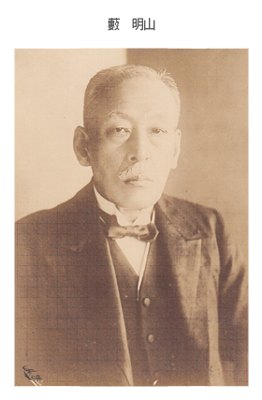
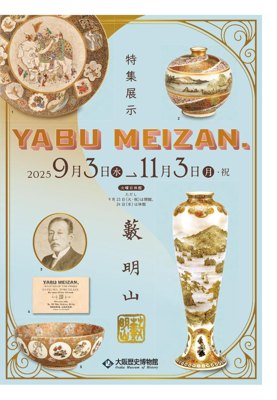
The museum in Meizan’s home city holds the principal Japanese research collection. It includes finished works, undecorated blanks, the copper plates used for transfer underdrawings, Meizan’s portrait photograph and his business card.15,16 Among the works are a large vase with Mount Fuji, wisteria and peacocks; a vase with the shrine at Miyajima; and an early charger with a white elephant and children, marked “Meizan sei”.15,16 The museum mounted exhibitions on Meizan in 2005 and 2025, and its curator Nakano Tomoko has published the most detailed recent research on the studio.16,17,18
Museum of Contemporary Ceramic Art, Shigaraki Ceramic Cultural Park
The Tetsuro Tanabe Collection at Shigaraki includes a bowl with birds and butterflies among peonies, dated to the Meiji period. Its mark is recorded as a seal reading only 「明山」 (Meizan), which is relevant to the open question of when the plain “Meizan” mark was used.19
This list is updated as records are confirmed. Holdings reported elsewhere but not yet checked against the museum’s own records are not listed. If you know of a public holding we have missed, please let us know.
Notes and sources
- Victoria and Albert Museum, C.252-1910. collections.vam.ac.uk/item/O171087/bowl-yabu-meizan-workshop
- Victoria and Albert Museum, C.225-1910. collections.vam.ac.uk/item/O171086
- Victoria and Albert Museum, C.231-1910. collections.vam.ac.uk/item/O496033/vase-yabu-meizan-workshop
- British Museum, producer record “Yabu Meizan” (BIOG3788). www.britishmuseum.org/collection/term/BIOG3788
- British Museum, 2014,3064.27.a (teapot from a sencha set). www.britishmuseum.org/collection/object/A_2014-3064-27-a
- British Museum, 1981,0808.36 (lidded box). www.britishmuseum.org/collection/object/A_1981-0808-36
- Khalili Collections, Meiji no Takara: Treasures of Imperial Japan. Ceramics, Part Two: Earthenware (Impey and Fairley, 1995). www.khalilicollections.org/portfolio/meiji-no-takara-treasures-of-imperial-japan-ceramics-part-two-earthenware
- Khalili Collections, Japanese Art of the Meiji Period, S 30. khalilicollections.org/collections/japanese-art-of-the-meiji-period/khalili-collection-japanese-art-of-the-meiji-period-bowl-s30
- Khalili Collections, Japanese Art of the Meiji Period, S 128. khalilicollections.org/collections/japanese-art-of-the-meiji-period/khalili-collection-japanese-art-of-the-meiji-period-bowl-s128
- Walters Art Museum, Baltimore, 49.2280, “Bowl with a Multitude of Women”. art.thewalters.org/object/49.2280
- Metropolitan Museum of Art, 46.39.11. www.metmuseum.org/art/collection/search/63332
- Metropolitan Museum of Art, 2012.485 (Shreve & Company goblet). www.metmuseum.org/art/collection/search/21463
- Ashmolean Museum, Oxford, EA1993.12. jameelcentre.ashmolean.org/object/EA1993.12
- Allen Memorial Art Museum, Oberlin College, 1904.330. allenartcollection.oberlin.edu/objects/2253/bowl-with-interior-design-of-butterflies
- Osaka Museum of History, collection feature “Yabu Meizan”. www.osakamushis.jp/collection/bijutsu/yabumeizan/yabumeizan.html
- Osaka Museum of History, special exhibition “Meizan Satsuma no bi” (31 August – 24 October 2005). www.osakamushis.jp/news/2005/meizan.html
- Osaka Museum of History, special exhibition “YABU MEIZAN” (3 September – 3 November 2025). www.osakamushis.jp/news/2025/yabumeizan.html
- Satsuma-database, “The Meizan Studio (1880–1941): Yabu Meizan and Yabu Tsuneo” (synthesising the research of Nakano Tomoko, Osaka Museum of History). www.satsuma-database.com/masters-from-edo-meiji-and-taisho-period/8-the-meizan-studio-1880-1941-yabu-meizan-and-yabu-tsuneo
- Shigaraki Ceramic Cultural Park, Museum of Contemporary Ceramic Art, digital museum feature on Yabu Meizan. digital-museum.sccp.jp/osusume/kamiwazanippon/yabu