
Yabu Meizan (藪明山, 1853–1934) founded and directed what was arguably the most refined Satsuma decorating studio of the Meiji era. His Osaka workshop is famous for crowded processions and festival scenes painted in enamels and gold, often at a scale that rewards a magnifying glass. This biography follows the documented record. Where the sources disagree, it presents each account.
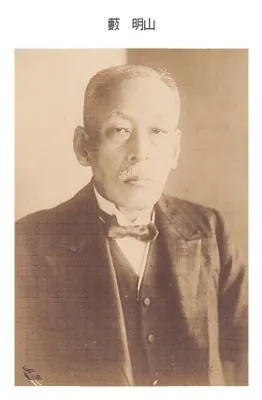
Family and early years

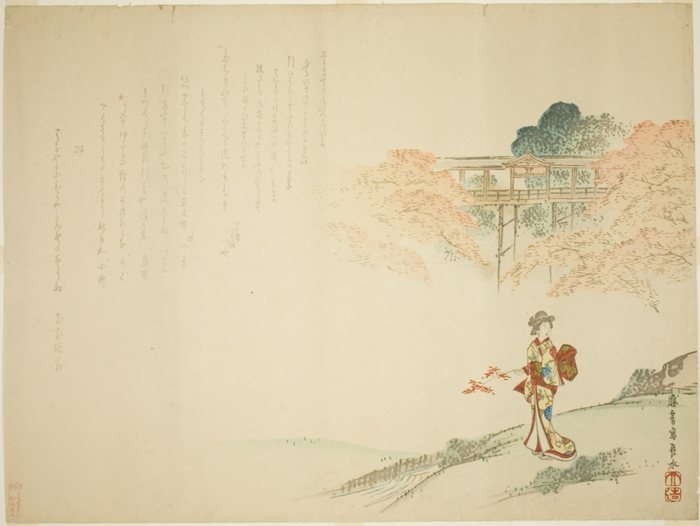
Meizan was born Yabu Masashichi (藪政七) on 20 January 1853 in Nagahori, Osaka.1,2 He was the second son of the painter Yabu Chōsui (藪長水). The Osaka Museum of History describes Chōsui as a painter in the literati (nanga) manner and dates him 1813–1867; Itani Yoshie gives 1814–1867.3,4,2 His grandfather was the Confucian scholar Yabu Kakudō (1773–1849).2 In 1860 the boy was made heir to the Yabu Sukezaemon family and moved to Fukura on Awaji Island. He returned to Osaka around 1868 for a commercial training.2,5 Itani suggests that his years on Awaji may have brought him into contact with the island’s Minpei pottery and its decorators. This is offered as a possibility, not a documented fact.2
The founding of the studio, 1880
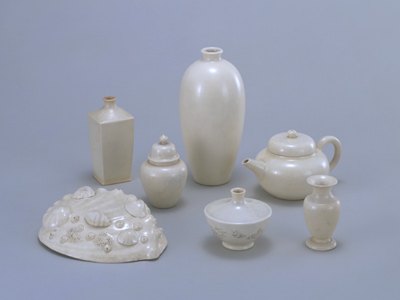
In 1880 Meizan went to Tokyo to learn the overglaze painting of Satsuma-style ceramics.4 Research by the Osaka Museum of History curator Nakano Tomoko, summarised by satsuma-database, places this stay between April and October.5 In October 1880 he opened a decorating workshop at Nakanoshima 2-chōme in Osaka.3 The studio never fired its own bodies. It bought finished, undecorated blanks: at first from Kyoto’s Awata kilns, such as the Taizan kiln, and later from the Chin Jukan kilns in Kagoshima and the Kinkozan workshop in Kyoto.3,5,6 A British Museum tea service makes the point neatly: its body is catalogued as made in Kagoshima, its decoration as done in Osaka.7

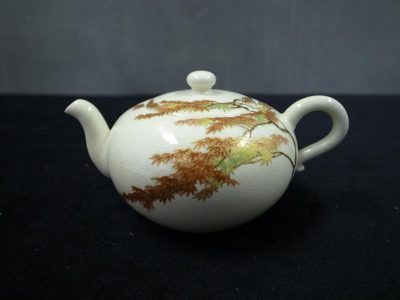
Around 1888 the business moved to Dōjima in Osaka and began selling directly to foreign clients. According to satsuma-database, both sites were chosen for their access to waterways and rail.5 An important partner in these years was the Christian Satsuma dealer Hirase Yoichirō, who had ties to the American Board missionaries. Nakano has devoted a study to the relationship between the two men.5
The studio and its painters
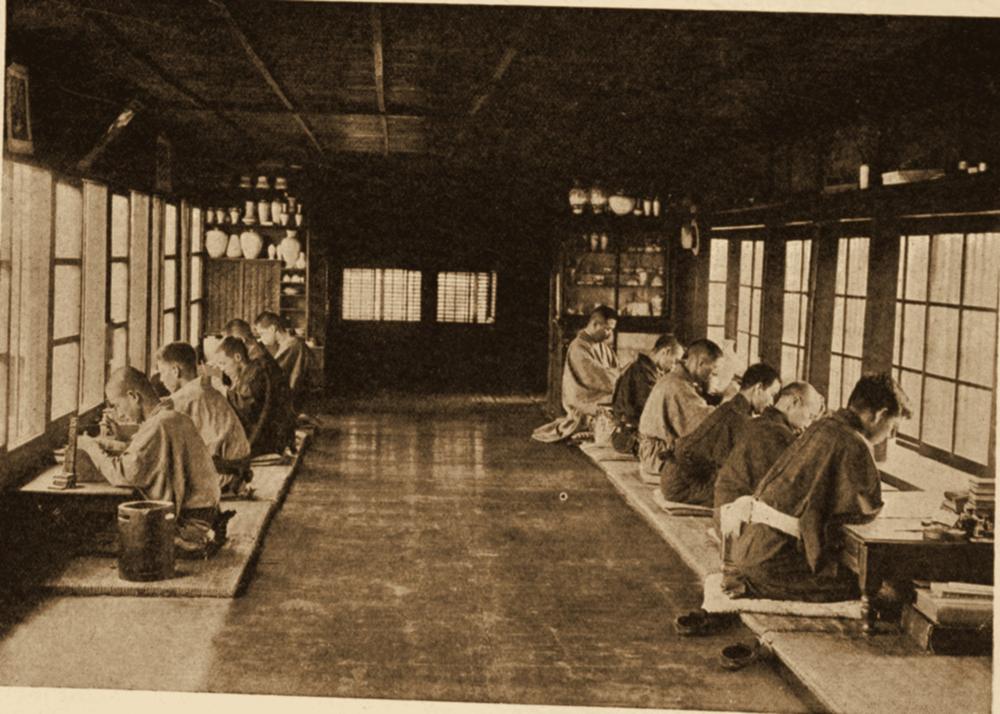
Meizan’s role was that of designer, art director and businessman. The Missouri collector Charles Parsons visited in 1894–95 and recorded that Meizan “had 17 men and boys at work, all decorating. He makes the designs and watches them carefully in executing the work.”8 Nakano’s research goes further. It questions whether Meizan had the technical training to paint the wares himself, and treats the output as the work of skilled, mostly anonymous decorators working under his direction.5 By 1891 his adopted heir, Yabu Tsuneo, was already working in the studio; an 1891 report in the Manchester Guardian, quoted by Louis Lawrence, calls him Meizan’s “brother”.5
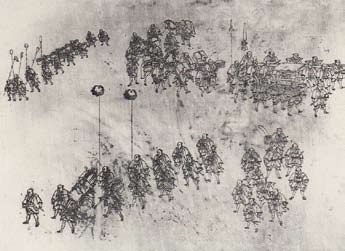
The studio’s designs were standardised with engraved copper plates. A design was printed onto thin paper and transferred to the blank as an underdrawing for the painters to follow, and many of these plates survive.2,3,9 Itani relates the studio’s views of Mount Fuji, the Gion Festival, Kasuga Shrine, Lake Biwa and Itsukushima to copperplate landscape prints published in the Kyoto–Osaka region.2 Satsuma-database reports a further suggestion by Nakano: that some wares sold under the Meizan name were subcontracted, for example to Kinkozan’s Kyoto workshops. It remains a hypothesis.5
Style
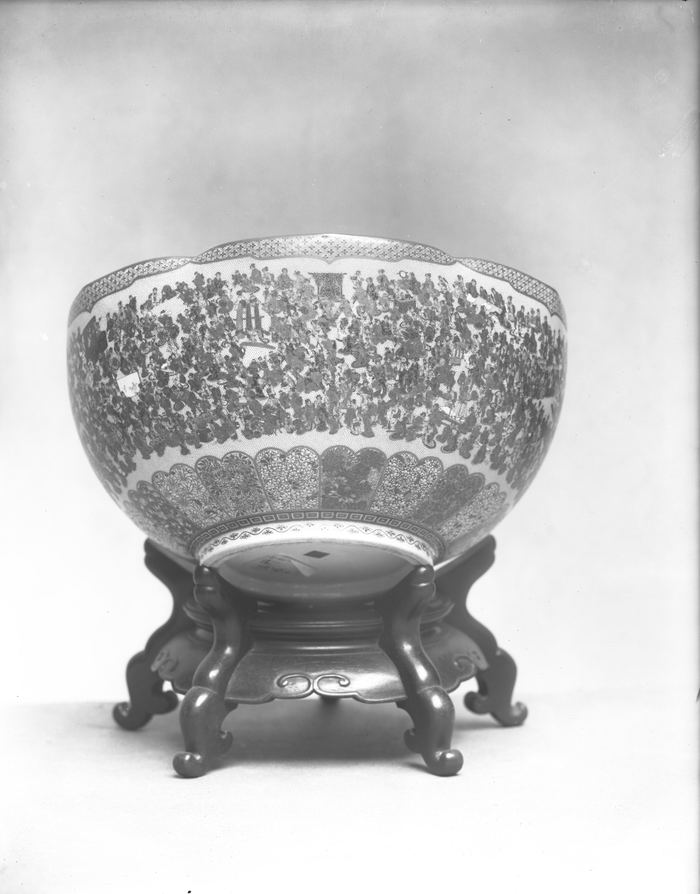

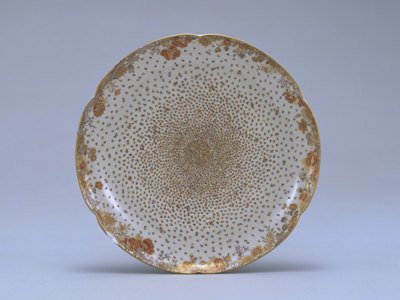
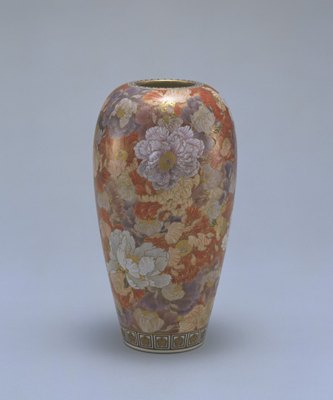
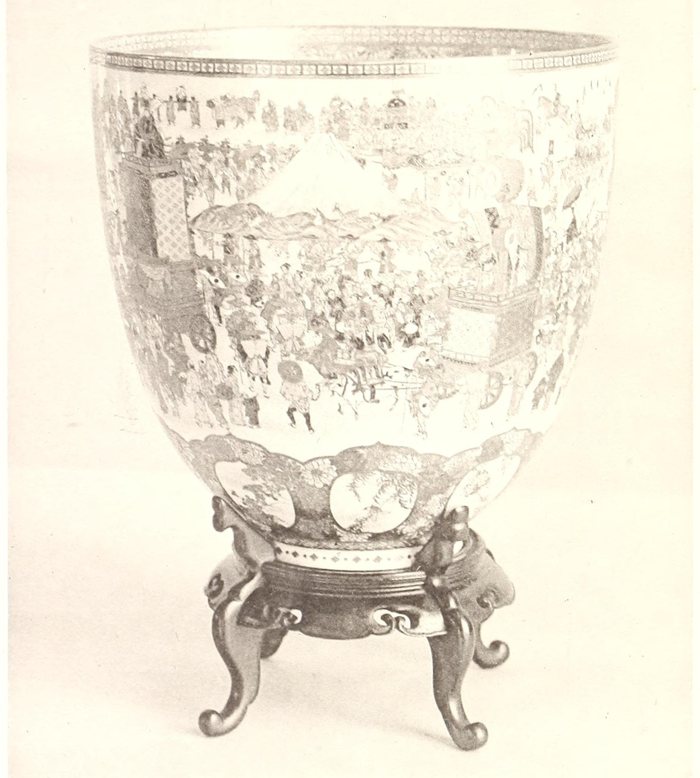
The studio is celebrated for dense, minute decoration in polychrome enamels and gold over a finely crackled glaze. Its subjects include processions, festivals, crowds of women and children, landscapes, butterflies and millefleurs.5,1,10 Early work drew on Chinese and Buddhist themes. From around 1890, and above all for export, the studio turned to Japanese subjects.5,11 Around 1910 a sparer style appeared beside the crowded one: a single maple branch or a bird on a bough set against open ground. Critics admired it, but buyers continued to prefer the older, crowded manner.9,12
“He makes the designs and watches them carefully in executing the work.”
Exhibitions and honours


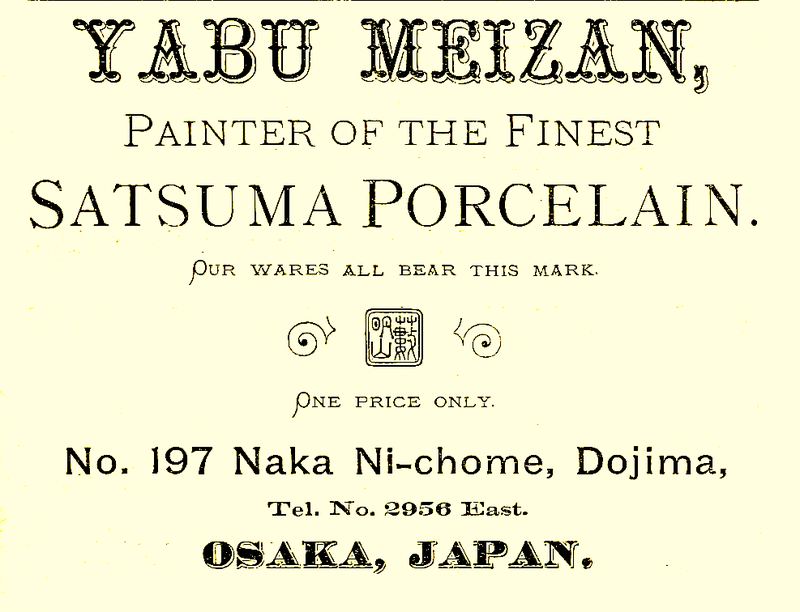
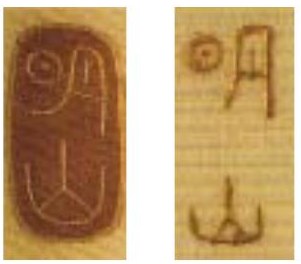
Meizan’s first recorded award was a bronze medal at the 14th Kyoto Exhibition of 1885.2 The Osaka Museum of History dates the studio’s international success from its showing at the Paris Exposition Universelle of 1889.4 His business card from these years reads “PAINTER OF THE FINEST SATSUMA PORCELAIN”.4
- 1885
14th Kyoto Exhibition: bronze medal.2
- 1889
Exposition Universelle, Paris: the studio exhibits, according to the Osaka Museum of History.4
- 1893
World’s Columbian Exposition, Chicago. The Osaka Museum of History records an anecdote that his miniature wares sold out at once.3
- 1900
Exposition Universelle, Paris: silver medal in the ceramic flower-vase category.2
- 1904
Louisiana Purchase Exposition, St Louis: gold medal. Meizan served as secretary of the Japan Exhibits Association. The Walters Art Museum bowl 49.2280 was bought there by Henry Walters.1,6
- 1910
Japan–British Exhibition, London. Three Meizan studio pieces entered the Victoria and Albert Museum that year, given by Lt-Col. Kenneth Dingwall with Art Fund support; the museum records that he bought at least two of them at the exhibition.2,10
- 1915
Panama–Pacific International Exposition, San Francisco.1
- 1920
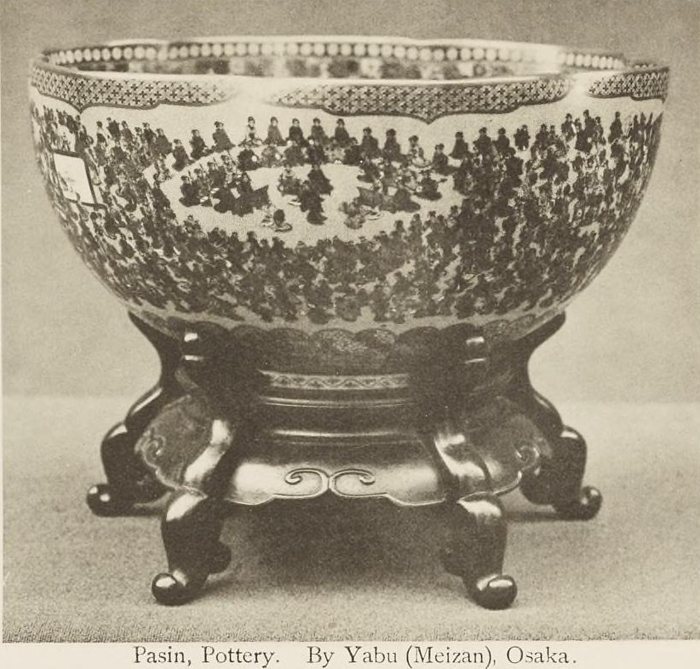
Bonhams and satsuma-database both describe Meizan as playing an organising role at these expositions, as well as exhibiting.11,5 Satsuma-database also reports a personal audience with the Emperor Meiji in 1895. This archive has not found that event in an independent source.5
Yabu Tsuneo, the second Meizan
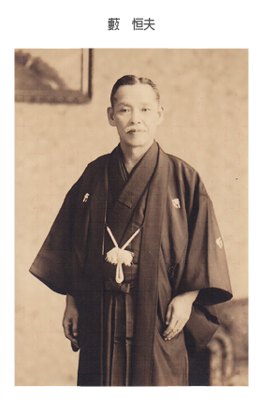
Meizan’s successor, Yabu Tsuneo (藪恒夫, 1868–1941), came from a samurai family of Tsuyama in present-day Okayama Prefecture. The Osaka Museum of History gives the family name as Nakanishi; satsuma-database gives both Nakanishi and Nakagawa.3,5 He was adopted in 1883 by the mother of Meizan’s wife, Kayo, and entered the Yabu family as heir in 1895. He became the second Meizan when Meizan retired in 1926.3,5 The small group of works attributed to him is signed simply “Meizan”. They tend to be livelier and more humorous than the studio’s earlier output; one vase shows a Hyakki Yagyō (night parade of demons) after Kawanabe Kyōsai.5 Bonhams catalogues such pieces under Tsuneo’s own name, as “active after 1926”.13
When did the studio end?
There is no single closing date, because the sources measure different things. The export trade suffered during the First World War.1
Four accounts of the studio’s end
- End of production, about 1912–1916. Nakano Tomoko, as summarised by satsuma-database, places the end of regular production in these years, with existing stock sold afterwards.5
- Closure, 1926. The year of Meizan’s retirement, given for the closure of the workshop by Wikipedia (citing Yamazaki 1995) and by the British Museum.1,14
- “Early Shōwa”. The Osaka Museum of History describes the workshop as active from 1880 until about the early Shōwa period (from 1926).3
- End of the studio name, 1941. Satsuma-database dates the “Meizan Studio” 1880–1941, ending with Tsuneo’s death.5

Meizan was a practising Christian. He died on 2 May 1934, and his funeral was held at Naniwa Church in Osaka.5,1 According to family records reported by satsuma-database, the studio buildings were later destroyed in the wartime bombing of Osaka. The same source gives both 1944 and June 1945 for this.5
Legacy and revival
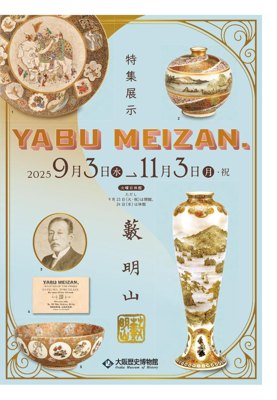

Even in his lifetime Meizan’s name attracted imitators. The Osaka Museum of History records copies marked “Dai Nihon Teikoku Kaga Kanazawa Meizan sei” (大日本帝国加賀金沢明山製).4 Joe Earle notes that another workshop used his name and imitated his style without matching its subtlety.1 Western collectors acquired his work early. Michael Tomkinson listed a covered Meizan jar in his published collection catalogue of 1898.15 Henry Walters bought at St Louis in 1904, and the Victoria and Albert Museum received its pieces in 1910, as a gift from a buyer at the Japan–British Exhibition.6,10
According to satsuma-database, Meizan’s reputation faded in Japan after 1941 and revived from 1991, helped by the efforts of his descendants.5 The largest group of his work is in the Khalili Collection, catalogued by Oliver Impey and Malcolm Fairley in 1995 with a biography by Yamazaki Tsuyoshi.16 The Osaka Museum of History, home of the principal Japanese research collection, devoted exhibitions to him in 2005 and 2025.4,17
Notes and sources
- Wikipedia, “Yabu Meizan” (citing Library of Congress authority file; Yamazaki Tsuyoshi in Impey and Fairley 1995; Earle 1999; Launius 2020). en.wikipedia.org/wiki/Yabu_Meizan
- Itani Yoshie, “The Design Philosophy of Yabu Meizan: Landscapes of Western Japan in Copperplate”, Journal of the Asian Conference of Design History and Theory 3 (2020), doi:10.18910/90920. ir.library.osaka-u.ac.jp/repo/ouka/all/90920/acdht_03_072.pdf
- Osaka Museum of History, collection feature “Yabu Meizan”. www.osakamushis.jp/collection/bijutsu/yabumeizan/yabumeizan.html
- Osaka Museum of History, special exhibition “Meizan Satsuma no bi” (31 August – 24 October 2005). www.osakamushis.jp/news/2005/meizan.html
- Satsuma-database, “The Meizan Studio (1880–1941): Yabu Meizan and Yabu Tsuneo” (synthesising the research of Nakano Tomoko, Osaka Museum of History). www.satsuma-database.com/masters-from-edo-meiji-and-taisho-period/8-the-meizan-studio-1880-1941-yabu-meizan-and-yabu-tsuneo
- Walters Art Museum, Baltimore, 49.2280, “Bowl with a Multitude of Women”. art.thewalters.org/object/49.2280
- British Museum, 2014,3064.27.a (teapot from a sencha set). www.britishmuseum.org/collection/object/A_2014-3064-27-a
- Charles Parsons, Notes of a Trip around the World in 1894 and 1895 (St Louis: G. D. Bernard & Co., 1896), p. 27. archive.org/details/notesoftriparoun00pars (full text; first quoted online by Jacksons Antique).
- Ashmolean Museum, Oxford, EA1993.12. jameelcentre.ashmolean.org/object/EA1993.12
- Victoria and Albert Museum, C.252-1910, C.225-1910 and C.231-1910: each “Given by Lieutenant-Colonel Kenneth Dingwall DSO with Art Fund support, accessioned in 1910”; the records for C.252-1910 and C.225-1910 add that the piece “was bought by their donor at the Japan-British Exhibition held in London in 1910”. O171087, O171086, O496033
- Bonhams, New York, 13 September 2017, sale 24293, lot 1286. www.bonhams.com/auction/24293/lot/1286/yabu-meizan-1853-1934-a-large-and-highly-important-satsuma-presentation-vasemeiji-era-1868-1912-early-20th-century
- Khalili Collections, Japanese Art of the Meiji Period, S 128. khalilicollections.org/collections/japanese-art-of-the-meiji-period/khalili-collection-japanese-art-of-the-meiji-period-bowl-s128
- Bonhams, New York, 11 September 2019, sale 25575, lot 875 (Yabu Tsuneo, active after 1926). www.bonhams.com/auction/25575/lot/875/yabu-tsuneo-active-after-1926-a-pair-of-gourd-shaped-satsuma-vasesshowa-era-1926-1989-20th-century
- British Museum, producer record “Yabu Meizan” (BIOG3788). www.britishmuseum.org/collection/term/BIOG3788
- Bonhams, London, 15 May 2014, sale 21861, lot 464 (Tomkinson provenance). www.bonhams.com/auction/21861/lot/464/a-small-ovoid-satsuma-jar-and-cover-by-yabu-meizan-meiji-period
- Khalili Collections, Meiji no Takara: Treasures of Imperial Japan. Ceramics, Part Two: Earthenware (Impey and Fairley, 1995). www.khalilicollections.org/portfolio/meiji-no-takara-treasures-of-imperial-japan-ceramics-part-two-earthenware
- Osaka Museum of History, special exhibition “YABU MEIZAN” (3 September – 3 November 2025). www.osakamushis.jp/news/2025/yabumeizan.html