
To Western buyers of the Meiji era, “Satsuma” meant an ivory-toned ceramic with a fine crackle, painted in coloured enamels and gold. The name came from a province in southern Kyushu, but by Meizan’s time it described a style made across Japan. Meizan’s Osaka studio was a decorator within that system, not a kiln.

Origins in Kagoshima
The history of Satsuma ware begins with Korean potters brought to Japan by the daimyō Shimazu Yoshihiro after Toyotomi Hideyoshi’s invasions of Korea. In 1598 several dozen of them landed at sites in what is now Kagoshima Prefecture.1 The local tradition grew to include shiro-Satsuma (white Satsuma), with a colourless or pale yellow crackled glaze; kuro-Satsuma (black Satsuma), with coloured glazes; and porcelains. It is usually grouped by kiln lineage: Tateno, Naeshirogawa, Ryūmonji, Nishimochida and Hirasa.1 It was the white, crackle-glazed body that became the canvas for export decoration.2


From Hon-Satsuma to “SATSUMA”

Enamel painting on white Satsuma, enriched with gold to create Satsuma kinrande (“gold-brocade” Satsuma), was admired at the Paris Exposition of 1867 and at Vienna in 1873. The success prompted Kyoto kilns to make wares in the same style.2 In Japan, the Kyoto product became known as Kyō-Satsuma, as distinct from Hon-Satsuma, the “original” Satsuma of Kagoshima. During the Meiji era, production spread further, and dealers spoke of Kobe-Satsuma, Osaka-Satsuma and Yokohama-Satsuma. Abroad, all were sold under the single name “SATSUMA”.2 One Japanese study of the export trade lists the features of this ware as foreign buyers knew it:3
- polychrome enamels and gold;
- a crackled glaze over a yellowish body;
- “Oriental” subjects such as samurai, Japanese women, rakan, dragons, phoenixes, flowers, birds and insects;
- dense, pictorial decoration with little empty space;
- marks such as the Shimazu crest, “Satsuma”, or “Dai Nihon … tsukuru”.
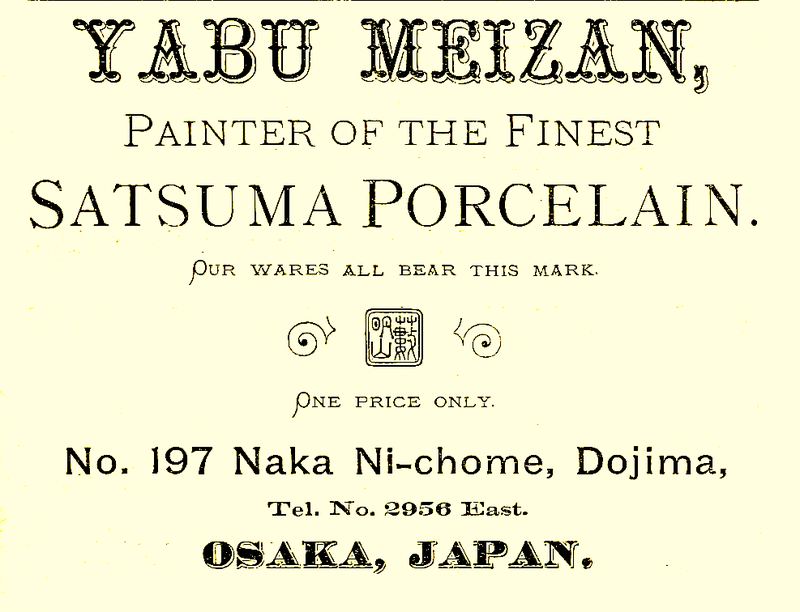
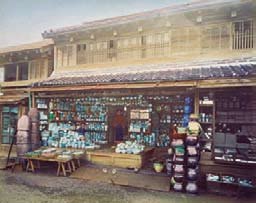
Meizan’s studio worked at the most refined end of this spectrum. The Kiyomizu Sannenzaka Museum in Kyoto, which exhibits Kyoto Satsuma, groups his work and that of Seikozan with the finest Osaka and Kobe Satsuma.2
How a Meizan piece was made
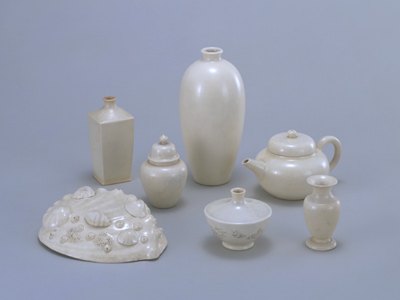
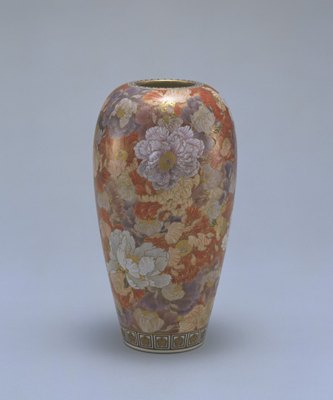
Before and after: undecorated blanks and a finished vase from the Meizan studio, both in the Osaka Museum of History.
The documented process of the Meizan studio shows how the system worked in practice.
- The blank
The studio bought glazed, undecorated bodies from other makers. It used Awata kilns in Kyoto (such as the Taizan kiln) at first, and later Chin Jukan in Kagoshima and Kinkozan in Kyoto.4,5,6 A British Museum tea service is catalogued with a Kagoshima body and Osaka decoration.7
- The design
Meizan supplied the designs.8 They were engraved on copper plates, printed onto thin paper and transferred to the blank as an underdrawing. Copper plates and blanks bearing these transferred outlines survive in the Osaka Museum of History.9,4
- The painting
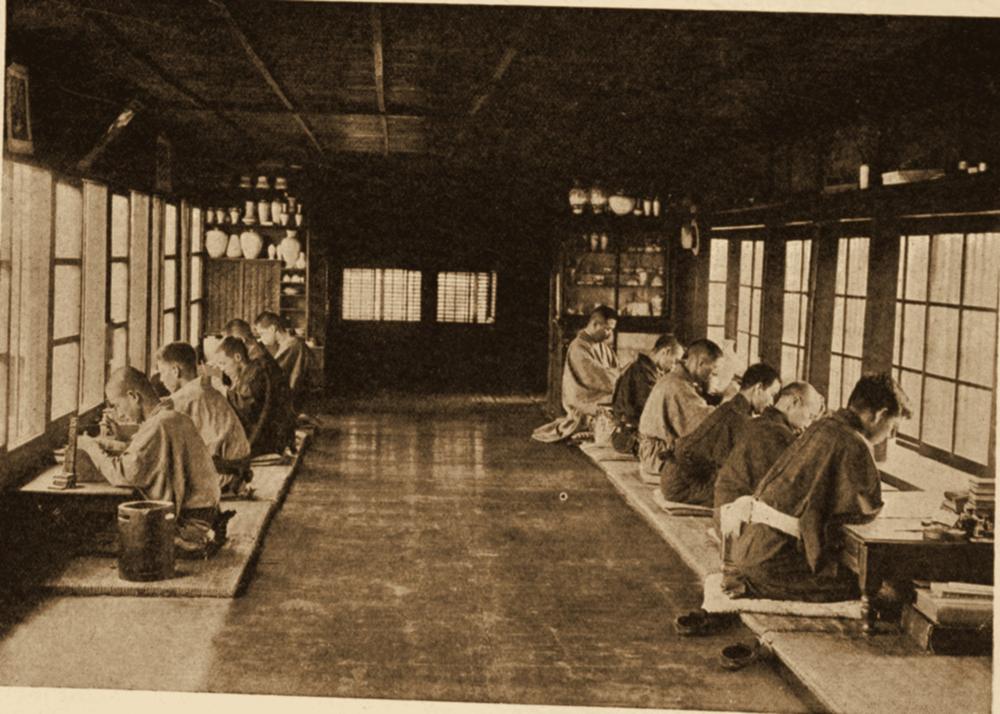
A team of decorators painted the design in overglaze enamels and gold. In 1894–95 Charles Parsons counted seventeen “men and boys” at work under Meizan’s eye.8 Some designs are so small that they need magnification to read properly.5
- The mark
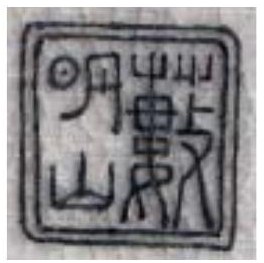
The finished piece was signed with the studio mark, usually “Yabu Meizan” in a gilt square cartouche.10,5 Satsuma-database notes that Satsuma signatures act as studio or brand marks rather than the signatures of individual painters.11
The studio system and its neighbours


Meizan’s was one of several decorating businesses whose names appear on the base of Meiji Satsuma. Others include the Kinkozan workshop of Awata in Kyoto, associated with Kinkozan Sōbei VII (1868–1927), which was also one of Meizan’s blank suppliers;2,6 Okamoto Ryozan, who decorated for the Yasuda Company;12 and Seikozan, associated with Kobe Satsuma.2 Named painters such as Sozan also worked for Kinkozan.13 The way the trade was organised, with blanks, painters and dealers in different hands, is why marks matter so much in attribution, and why they must be read with care. See Marks & Signatures.
Notes and sources
- Kagoshima Prefectural Museum of Culture Reimeikan, “Satsuma-yaki” (Japanese). www.pref.kagoshima.jp/reimeikan/josetsu/bumon/art/satsumayaki/index.html
- Kiyomizu Sannenzaka Museum, Kyoto, special exhibition “Kyoto Satsuma ware”. sannenzaka-museum.co.jp/en/special_exhibition/%e4%ba%ac%e8%96%a9%e6%91%a9-3-2
- “Kindai Nihon ni okeru Ōbei-muke Satsuma-yaki no yushutsu” [The export of Satsuma ware to Europe and America in modern Japan], Kōtsūshi Kenkyū 79 (J-STAGE, Japanese). www.jstage.jst.go.jp/article/kotsushi/79/0/79_KJ00010037865/_pdf/-char/ja
- Osaka Museum of History, collection feature “Yabu Meizan”. www.osakamushis.jp/collection/bijutsu/yabumeizan/yabumeizan.html
- Satsuma-database, “The Meizan Studio (1880–1941): Yabu Meizan and Yabu Tsuneo” (synthesising the research of Nakano Tomoko, Osaka Museum of History). www.satsuma-database.com/masters-from-edo-meiji-and-taisho-period/8-the-meizan-studio-1880-1941-yabu-meizan-and-yabu-tsuneo
- Walters Art Museum, Baltimore, 49.2280, “Bowl with a Multitude of Women”. art.thewalters.org/object/49.2280
- British Museum, 2014,3064.27.a (teapot from a sencha set). www.britishmuseum.org/collection/object/A_2014-3064-27-a
- Charles Parsons, Notes of a Trip around the World in 1894 and 1895 (St Louis: G. D. Bernard & Co., 1896), p. 27. archive.org/details/notesoftriparoun00pars (full text; first quoted online by Jacksons Antique).
- Itani Yoshie, “The Design Philosophy of Yabu Meizan: Landscapes of Western Japan in Copperplate”, Journal of the Asian Conference of Design History and Theory 3 (2020), doi:10.18910/90920. ir.library.osaka-u.ac.jp/repo/ouka/all/90920/acdht_03_072.pdf
- Victoria and Albert Museum, C.252-1910. collections.vam.ac.uk/item/O171087/bowl-yabu-meizan-workshop
- Satsuma-database, “Marks & Makers”. www.satsuma-database.com/marks-makers-1
- Bonhams, New York, 11 September 2019, sale 25575, lot 879 (Okamoto Ryozan for the Yasuda Company). www.bonhams.com/auction/25575/lot/879/okamoto-ryozan-for-the-yasuda-company-a-fine-satsuma-incense-burnermeiji-era-1868-1912-late-19th-century
- Bonhams, New York, 11 September 2019, sale 25575, lot 881 (Sozan for the Kinkozan workshop). www.bonhams.com/auction/25575/lot/881/sozan-for-the-kinkozan-workshop-circa-1900-a-large-and-fine-satsuma-vasemeiji-era-1868-1912-early-20th-century
- Bonhams, New York, 16 September 2014, sale 21786, lot 2267. www.bonhams.com/auction/21786/lot/2267/a-fine-satsuma-vase-by-yabu-meizan-meiji-period-late-19th-century
- Bonhams, New York, 20 March 2019, sale 25415, lot 338. www.bonhams.com/auction/25415/lot/338/yabu-meizan-1853-1934-a-fine-and-large-satsuma-vasemeiji-era-1868-1912-circa-1900